Why it matters
A cooking recipe tells you how to prepare a dish; a preservation process also has to control hazards during storage. Similar ingredients do not establish that two processes are interchangeable. Learning to read the full source before preparing food is a practical skill that prevents last-minute substitutions and unsupported shelf-storage claims.
What you’ll need
Tools
- Complete source publication
- Notebook
- Measuring equipment specified by the recipe
Materials
- Recipe checklist
- Local elevation information if canning
Before you begin
Safety & limits
- Do not invent processing times, add unapproved thickeners or reduce required acid. A home pH reading alone cannot validate heat penetration or create a safe canning schedule.
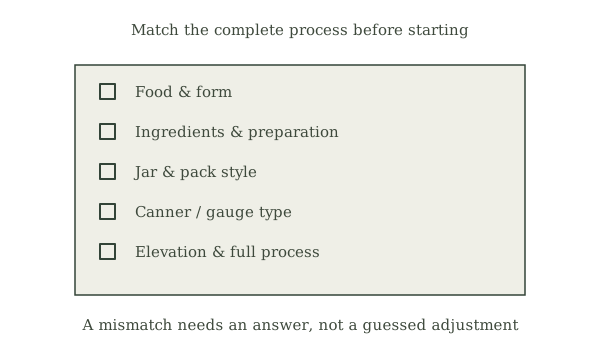
- A sealed jar is not proof of a safe process. When no tested process matches the intended product, select a supported alternative rather than adapting an unrelated recipe.
Work carefully, in order
The method
- 01
Define the intended result
Write down the exact food and whether you want refrigerator storage, frozen storage or a shelf-stable canned product. These are different goals. A refrigerator pickle cannot become a pantry pickle just because the lid seals. Include the form of the food—pieces, purée or juice—because it changes which published processes may apply.
- 02
Locate the complete authoritative source
Start with a recognized food-preservation center, agricultural extension service or government publication. Follow a reposted recipe back to its original source. Save its title and version or access date, including linked general directions. For canning, the NCHFP collection is a useful starting point. A social-media card without the complete process is not enough to work from.
- 03
Match every relevant condition
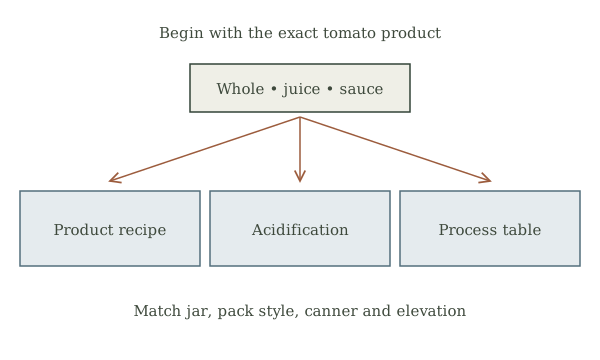
Read ingredients, preparation, pack style, jar sizes, headspace, canner type, processing instructions and storage requirements. Check required acid strength and any explicitly permitted substitutions. Confirm you have the specified equipment before buying a large quantity of produce. A larger jar or thicker food is not a harmless change merely because the ingredients have familiar names.
- 04
Read the correct processing table
For canning, identify the row and column for the food, pack style, jar size, elevation and canner or gauge type as applicable. Copy the selected directions into a preparation checklist and check them again against the source. Do not combine the shortest time from one table with the lowest pressure from another. Keep cooling instructions as part of the process.
- 05
Resolve gaps before beginning
If the source is incomplete or your intended product differs, stop preparation and ask an extension food-preservation specialist. Select a tested recipe that fits, or choose an appropriate refrigerator/freezer preparation instead. Record the chosen source with the batch. During work, document deviations honestly and obtain advice; do not assume extra heating afterward repairs an unknown error.
Mistakes to avoid
- Treating a family recipe’s good reputation as a tested process.
- Reading the ingredient list while skipping the linked general instructions.
If it isn’t working
The available jars are a different size
Find explicit directions that cover them, obtain the required jars or choose another supported method. Do not scale processing time by volume.
Two authorities give different instructions
Check product, method and publication context. Follow one complete applicable process and ask a specialist if the difference remains unresolved.
Then & now
Historical context
Handwritten family recipes preserve taste and memory. Their age or popularity does not establish a safe modern canning process. Keep their historical value while choosing a currently supported method for food that will be stored.
The modern equivalent
Searchable preservation databases make tested processes easier to locate. A careful reader still has to match the process to the actual task.
Sources & review
Editorial draft — specialist review pending. Written 2026-09-22. Sources support the stated scope; this page has not been professionally certified.
- NCHFP — ensuring safe canned foods ↗
Research-based processing and the relationship between acidity and canning method. Checked 2026-09-22.
- NCHFP — selecting the correct processing time ↗
Matching process tables to pack, jar, canner and elevation, including cooling requirements. Checked 2026-09-22.
- NCHFP — canning collection ↗
Product-specific authoritative processes and general directions. Checked 2026-09-22.