Why it matters
A freezer full of unmarked packages turns useful food into guesswork. A label identifies a container; a batch record explains the work behind it. Keeping them connected helps a second household member find instructions and helps you identify every container affected if a preparation error is discovered later.
What you’ll need
Tools
- Notebook or spreadsheet
- Permanent marker
Materials
- Labels suitable for storage conditions
- Recipe source
- Food containers
Before you begin
Safety & limits
- A label, a sealed lid or a complete record does not prove that food is safe. Never invent a processing result, storage history or shelf life to fill a blank.
- This is a household system, not a commercial labeling compliance guide. Before sharing food, communicate ingredients and storage needs; do not claim allergen-free preparation without appropriate controls.
Work carefully, in order
The method
- 01
Give the batch an unambiguous identity
Choose a short code such as 2026-09-22-A and write it at the top of a new record. Use the same code on every package from that preparation session. Record the food name, preparation date and who did the work. A letter separates two batches made on the same day without relying on container position or lid color.
- 02
Record the source before preparing food
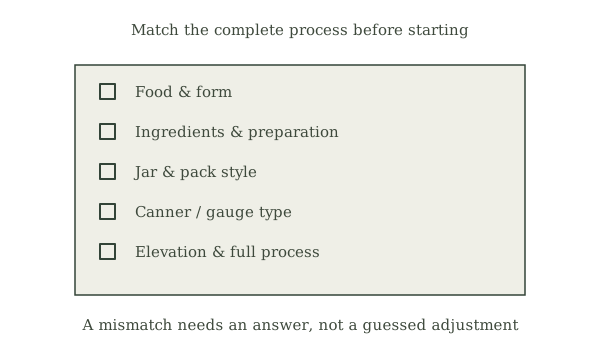
Write the recipe title, publisher, link and edition or access date. Note the intended method and required storage. Keep the complete recipe available; a log is not a shortened substitute. Record ingredients and relevant product details, including allergen information. For canning, include the prescribed pack style, jar size, elevation and equipment type so the selected process can be traced.
- 03
Record what actually happened
Write observations during the task rather than reconstructing them at night. Include relevant actual measurements with units, times, number of containers and any interruption or deviation. Keep intended values separate from observed values. If something went wrong, describe it plainly and seek qualified guidance; neatly completed columns cannot compensate for an unsafe process.
- 04
Make the container understandable on its own
Add the food name, batch code, date, amount or servings, ingredients or a clear ingredient-record reference, and required storage. State whether food is raw or cooked when that is not obvious. Use labels that remain readable in the freezer. Example for an already safely prepared batch: cooked vegetable soup; batch 2026-09-22-A; two portions; keep frozen. That example assigns no shelf life.
- 05
Maintain the link as food is used
Record where packages are stored and cross them off as they are used or discarded. Add thawing or opening dates when relevant. Keep older suitable stock easy to reach, but assess condition and storage history rather than using age alone. Before giving someone food, provide the ingredient information and storage instructions with the container, not in a notebook they cannot access.
Mistakes to avoid
- Writing only “September” on several different foods.
- Copying the recipe’s target into the observed-temperature column.
If it isn’t working
A label falls off
Reidentify it only from reliable records. Do not guess the contents or safety of an uncertain package.
A process error is discovered
Use the batch code to locate affected containers and prevent use while obtaining appropriate food-safety advice.
Then & now
Historical context
Pantry ledgers and handwritten jar labels made seasonal stores manageable. A modern household record adds source versions and explicit storage instructions while preserving the same practical habit of writing things down at the time.
The modern equivalent
A spreadsheet can search and total stock, while a pencil log works without power. Either needs a readable identifier on the food itself.
Sources & review
Editorial draft — specialist review pending. Written 2026-09-22. Sources support the stated scope; this page has not been professionally certified.
- NCHFP — packaging and labeling foods ↗
Freezer package identification, meal portions and expansion space. Checked 2026-09-22.
- University of Minnesota Extension — labeling cottage food items ↗
Relationship between dates, recipes and batch records; commercial Minnesota rules are not adopted as household requirements. Checked 2026-09-22.
- NCHFP — storing home canned foods ↗
Identification and storage after a correctly followed tested process. Checked 2026-09-22.