Why it matters
Tomato acidity varies, and a sauce or salsa may behave differently from whole tomatoes. The selected tested process determines preparation, acidification and how the jars are processed. Recording all those choices before harvest day prevents a familiar tomato from becoming an improvised low-acid canning experiment.
What you’ll need
Tools
- Complete product-specific NCHFP or extension recipe
- Appropriate canner and jars
- Accurate ingredient measures
- Local elevation information
Materials
- Sound tomatoes
- Specified bottled lemon juice, citric acid or other acid allowed by the particular tested recipe
- Labels
Before this skill
- Choosing Tested Preservation Recipes
- Checking Home Canning Equipment
Before you begin
Safety & limits
- Use the complete currently published recipe and its acidification and processing directions. This overview supplies no universal tomato canning time or method.
- NCHFP requires acidification for its whole, crushed and juiced tomato procedures with both boiling-water and pressure processes; read the exact product page for its acid specification and exceptions.
- Do not add untested amounts of onion, pepper, oil or thickener, or assume a home pH test validates the mixture. Use a distinct tested salsa or sauce recipe if those ingredients are wanted.
Work carefully, in order
The method
- 01
Name the tomato product precisely
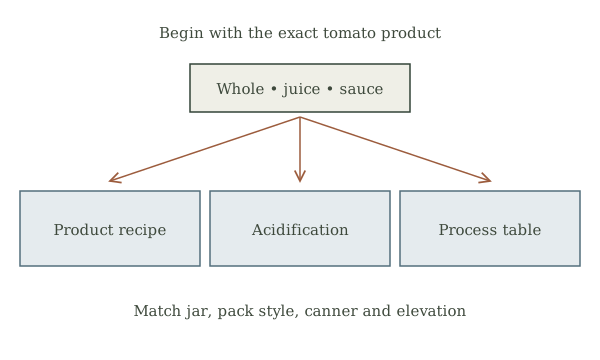
Decide whether the goal is whole or halved tomatoes, juice, crushed tomatoes, sauce or a mixed-ingredient product. Find a tested recipe that names that exact form. The way tomatoes are packed and concentrated matters; a table for whole tomatoes cannot automatically process a thick sauce or a salsa.
- 02
Read the full acidification directions
Open the acidification instructions that the product recipe links to. Match acid type, measured amount and jar size; bottled lemon juice and citric acid are described by NCHFP for its applicable recipes. Note that even its pressure-canning options for whole, crushed and juiced tomatoes require acidification. Do not substitute a squeeze of fresh lemon.
- 03
Match jars, equipment and elevation
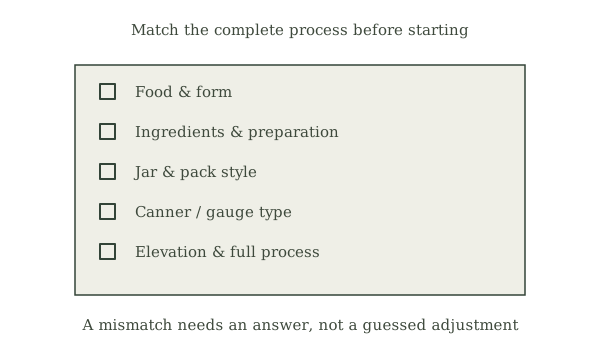
Record the chosen jar size, hot or raw pack where the recipe offers it, canner type and local elevation. Select the matching processing table from the same complete source. Check jar preparation and equipment readiness. If a table does not cover your desired jar size or method, obtain the correct setup before preparation.
- 04
Prepare the tomatoes as written
Sort out spoiled fruit and follow the source’s peeling, coring, heating or packing steps for the chosen product. Measure the specified acid exactly as directed; maintain headspace and pack style. Keep ingredients within the tested recipe, recording batch date and source version alongside any actual observations and departures.
- 05
Process and store according to the source
Follow the full product-specific canner instructions, including when timing begins, cooling, seal checks and storage. Label jars with their recipe and date. If the process was interrupted, a jar failed to seal, or an ingredient was omitted, seek current extension advice rather than assuming the lid makes the food safe.
Mistakes to avoid
- Treating all red tomatoes as naturally acidic enough for any canning process.
- Using the tomato-juice table for a dense sauce or salsa.
- Omitting acid because a pressure canner was chosen for a recipe that still requires it.
If it isn’t working
The tomatoes include extra onions or peppers
Find a tested recipe specifically for that mixture, or choose an appropriate refrigerated or frozen food instead.
The acid was forgotten after processing
Do not assume the jar is safe for pantry storage. Consult a food-preservation specialist about the batch and follow their disposal or recovery guidance.
Then & now
Historical context
Home tomato recipes are often passed down with taste as the main goal. A good flavor does not establish acidity, heat penetration or a safe process. Modern guides specify the product, acid, pack, jar and elevation together.
The modern equivalent
The NCHFP tomato collection links product-specific steps and acidification tables. Freezing prepared tomatoes is an option when a fitting tested canned recipe is unavailable.
Sources & review
Editorial draft — specialist review pending. Written 2026-09-24. Sources support the stated scope; this page has not been professionally certified.
- NCHFP — tomato acidification directions ↗
Measured acidification for the covered tomato products, including both canning methods. Checked 2026-09-24.
- NCHFP — canning tomatoes introduction ↗
Variation in tomato acidity and selecting product-specific guidance. Checked 2026-09-24.
- University of Minnesota Extension — pickling produce ↗
Variation in tomato acidity and need for acidification. Checked 2026-09-24.