Why it matters
The person at home needs actionable information rather than “we are hiking somewhere.” The outcome is a completed route/contact record and a simulated overdue report. This example covers a temperate woodland day walk in a US or Canadian 911 jurisdiction; confirm the actual land-manager and emergency contacts before a real trip.
What you’ll need
Tools
- Current route map
- Phone and destination contact information
- Printed or saved trip-plan form
- Clock with agreed time zone
Materials
- Group names and emergency details
- Route card from Route Planning
- Trusted contact who is not on the outing
Before this skill
- Route Planning
Before you begin
Safety & limits
- Do not wait for an agreed deadline if there is evidence of injury, distress or immediate danger. Never use this fictional example as a mandatory search delay.
- All rehearsal messages stay within the practice group. Do not file a false missing-person report or make a test emergency call.
- Share sensitive medical/contact data only with the trusted contact and appropriate responders; fictional data are sufficient for practice.
Work carefully, in order
The method
- 01
Choose the responsible contact
Ask a person who will be available and off the trip to hold the plan. Confirm they can read the map or route description and access the agreed contact details. If they cannot monitor the return window, choose another contact or change the outing. A message sent without acknowledgment is not a completed handoff.
- 02
Write the group and access details
Record participants, contact numbers, relevant needs, equipment, shelter and communication capability. Add destination, trailhead, route names, parking point and vehicle description where relevant. For practice use fictional names and a marked training map. The purpose is to help a receiver distinguish the group and its access point, not to collect unnecessary private information.
- 03
State the itinerary and permitted alternative
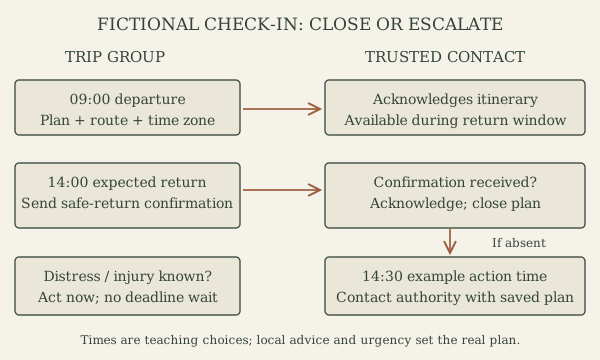
Attach the route card with departure, waypoints, return route, turnaround and known escape options. In the fictional example depart at 09:00 and aim to return at 14:00; the only fallback is the same-route early return. Record date and local time zone. Do not write “any nearby trail” as an alternative because it leaves the contact without a searchable plan.
- 04
Agree a concrete overdue action
For this classroom example the contact expects a safe-return confirmation by 14:30 and begins the agreed authority-contact procedure if it is absent. This is an illustrative choice, not a general waiting rule: set real times with terrain, weather, vulnerability and local authority guidance. Write which number to use, what checks are reasonable without delay, and what facts to report. An SOS or known injury overrides the timetable.
- 05
Rehearse both communication failures
The leader supplies two cards: an unread safe-return text, then a dead hiking phone. The contact tries the stated ordinary channels and prepares the authority report from the saved plan without traveling into the wilderness to search. Read the location, route, expected times, last contact and equipment aloud. Do not reset the deadline indefinitely because “their battery probably died.”
- 06
Close or amend the plan explicitly
The group must confirm safe return in a way the contact acknowledges. If a route change is possible before departure, send the changed plan and obtain acknowledgment; if that fails, keep the agreed plan or cancel. During a real trip communicate changes when able, but retain conservative limits. Completion is a contact who can explain both the closure signal and overdue action using the written record alone.
Mistakes to avoid
- Leaving the plan with another participant on the same trip
- Changing the route without informing the contact
- Treating the example’s grace window as required even after a distress report
If it isn’t working
The chosen contact is unavailable
Use an acknowledged replacement before departure. If no reliable contact exists, reassess the outing rather than assuming someone will notice.
The group returns but the contact does not reply
Use the pre-agreed alternate channel and make safe return clear. A plan needs closure so the contact is not left guessing.
Then & now
Historical context
Kephart’s outdoor notebooks show an early twentieth-century written-record tradition. Today the NPS trip-plan model formalizes information shared with a trusted contact. A modern check-in plan adds communications and explicit escalation; an old route note alone does not supply a rescue response.
The modern equivalent
Carry equipment suited to the actual season and learn with a qualified wilderness instructor. A nearby-refuge practice session prepares decisions; it does not certify independent backcountry competence.
Sources & review
Editorial draft — wilderness instructor review pending. Written 2026-10-06. Sources support the stated scope; this page has not been professionally certified.
- NPS — Trip Plan ↗
Itinerary and trusted-contact roles. Fictional route names, check-in times and escalation times here demonstrate recordkeeping, not a universal waiting period. Checked 2026-10-06.
- NPS — Outdoor Emergency Plan ↗
Lost-person assessment, safe retracing, contact information, remaining in place and rescue visibility. The tabletop scenarios and timings here are editorial exercises, not a rescue timetable. Checked 2026-10-06.
- NPS — Hike Smart ↗
Choose a route for the group, check conditions, keep together and set turnaround limits. The arithmetic and imaginary route card here are original examples. Checked 2026-10-06.
- Western Carolina University — Kephart outdoor writing archive ↗
Documents Horace Kephart’s outdoor notebooks and the 1916 expansion of Camping and Woodcraft. Provenance for the written-record tradition, not evidence for modern shelter or medical procedures. Checked 2026-10-06.