Why it matters
Pain and swelling alone cannot reliably distinguish a sprain from a fracture. Supporting the part without forcing it and choosing appropriate medical help matter more than proving a diagnosis by testing movement.
What you’ll need
Tools
- Phone
- First-aid training equipment
Materials
- Folded blanket or padding
- Wrapped cold pack
- Training splint and bandages used with an instructor
Before you begin
Safety & limits
- Call emergency services for deformity, an open fracture, a cold or numb limb, severe injury or inability to move the person safely. Do not straighten a limb, push exposed bone back, test weight bearing or improvise transport after a major injury. Splint application is an assessed training skill.
Work carefully, in order
The method
- 01
Stop activity and check hazards
Have the person stop using the injured part. Check how the injury happened and whether there are other injuries. Do not ask them to walk or move it to prove it is only a sprain. Suspect a fracture until assessed, particularly after substantial force or a fall.
- 02
Choose the level of help
Call emergency services for a bent limb, open injury, numbness, coldness, severe pain, major trauma or unsafe movement. Give the mechanism and location. For less severe injury arrange healthcare advice about assessment and safe transport. A lack of visible deformity does not exclude a fracture.
- 03
Support without repositioning
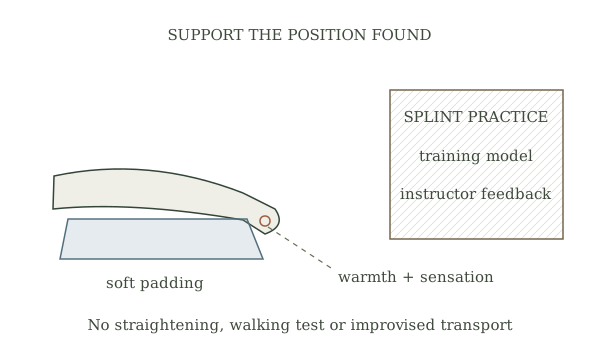
Help the person remain still in the position found, using soft padding around the injured part if comfortable. Do not pull it straight or bind it tightly. Leave suspected head, neck, spine or pelvic injury undisturbed unless movement is essential for safety or lifesaving care under emergency guidance.
- 04
Use cold carefully for a closed injury
For an appropriate closed injury, a cold pack wrapped in a thin dry towel may ease swelling. Apply for no more than 20 minutes and stop sooner if painful. Avoid ice directly on skin. Open wounds and serious bleeding require their own care; do not let the pack distract from those priorities.
- 05
Watch circulation and condition
Ask about sensation and compare warmth and colour beyond the injury without manipulating it. Report new numbness, coldness, discolouration or worsening pain urgently. Monitor breathing and response after major trauma. Give responders the mechanism, symptoms and care, and follow their transport instructions.
- 06
Learn splinting in a course
On a training model or supervised practice setup, learn how padding, support and bandage placement limit movement and how to check circulation before and after. Do not build a universal splint from this concept plate. Follow clinical advice on supports, gradual movement and return to activity after assessment.
Mistakes to avoid
- Forcing movement to diagnose a sprain
- Straightening a deformed limb
- Making a support so tight that circulation changes
If it isn’t working
Fingers or toes become numb or cold
Seek urgent help and report any applied support; follow emergency guidance instead of tightening it further.
You cannot move the person safely
Call emergency services and support them where they are rather than carrying them with an improvised splint.
Then & now
Historical context
Splints have long limited movement during transport. Modern first aid combines support with circulation checks and decisions about when movement itself creates unacceptable risk.
The modern equivalent
Medical assessment and an appropriate support, with first-aid splinting learned through practical instruction.
Sources & review
Editorial draft — specialist review pending. Written 2026-10-05. Sources support the stated scope; this page has not been professionally certified.
- American Red Cross — Fractures ↗
Potential fractures, emergency signs, support without straightening, cold packs and transport limits. Checked 2026-10-05.
- NHS — Sprains and Strains ↗
Minor injury protection and clinician-guided recovery after serious injury has been excluded. Checked 2026-10-05.