Why it matters
Decomposition creates habitat and recycles material, but soft wood has lost strength in ways a surface glance cannot quantify. A fallen log can be useful habitat; a dead limb over a path can be dangerous. This exercise teaches a boundary between field observation and structural judgment.
What you’ll need
Tools
- Notebook
- Camera
Materials
- Naturally fallen small wood
Before you begin
Safety & limits
- Do not enter beneath hanging limbs, push standing snags or test a large log by climbing on it. Ask a qualified arborist to assess a tree that threatens people or structures.
- Wear gloves if handling loose samples; avoid disturbing nests, fungi and decaying habitat unnecessarily.
Work carefully, in order
The method
- 01
Choose a safe sample
Select a small, fully detached piece lying on stable ground away from overhead damage. First look above and around it for hung branches and unstable trees. Leave a log that supports other material or shelters animals undisturbed.
- 02
Compare surfaces
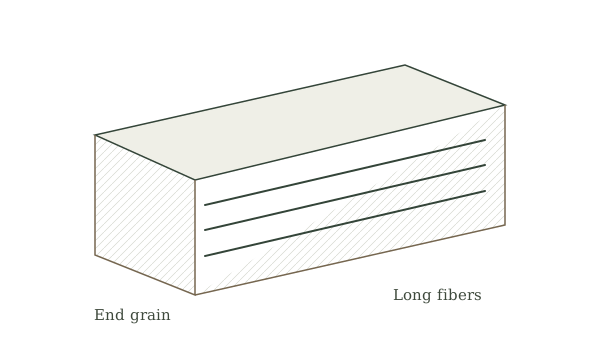
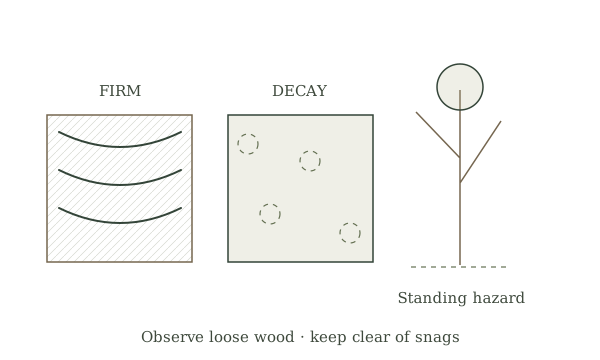
Observe intact bark, exposed grain, color, cracks and visible fungal growth. A firm outer shell can hide soft inner wood, while surface discoloration alone does not prove deep decay. Photograph both ends without cutting into a standing tree.
- 03
Feel only loose material
With gloves, gently compare a naturally broken edge of the detached piece with sound wood nearby. Note whether fibers hold together, crumble or feel spongy. These are descriptive observations, not a load rating or species diagnosis.
- 04
Read the setting
Record moisture, contact with soil and whether the piece lies under a tree with dead branches. Fungi and invertebrates often use decaying wood. If a nearby standing tree or limb could fall onto a route, mark the location from a safe distance and seek professional assessment.
- 05
Leave or use responsibly
Retain suitable down wood for habitat where it poses no local fire or access concern. Do not use uncertain decayed wood for steps, supports, handles or load-bearing projects. Record the observation rather than removing every fallen piece.
Mistakes to avoid
- Equating bark color with internal strength
- Treating a snag like a loose ground sample
- Clearing all deadwood from habitat
If it isn’t working
A standing tree has conks or a cavity
Keep people clear of the potential fall area and request qualified tree-risk advice.
The ground piece is pinned
Leave it; compression and support may change when moved.
Then & now
Historical context
Woodland workers have long judged decay by sound and texture. Modern tree-risk assessment requires training and considers the whole tree, its targets and site conditions.
The modern equivalent
A qualified arborist can assess tree risk; timber grading and testing address specific wood uses.
Sources & review
Editorial draft — specialist review pending. Written 2026-09-28. Sources support the stated scope; this page has not been professionally certified.
- University of Minnesota Extension — Cavity trees, snags, and deadwood ↗
Habitat value and professional removal near targets. Checked 2026-09-28.
- Penn State Extension — Tractors in the woods ↗
Dead limbs, hung trees and stored-energy hazards. Checked 2026-09-28.