Why it matters
Wood is directional material. Fibers carry loads differently along and across the grain, and moisture movement is uneven. Surface figure is a clue to the underlying fibers, but knots and changing grain can interrupt an apparently simple pattern.
What you’ll need
Tools
- Hand lens
- Pencil
Materials
- Offcuts with visible grain
Work carefully, in order
The method
- 01
Locate the three views
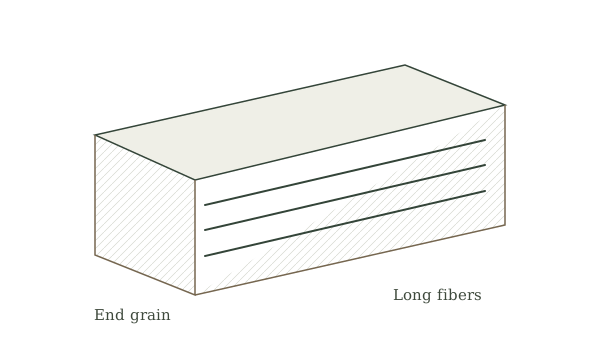
Compare end grain, face grain, and edge grain on one offcut. Trace growth-ring shapes on the end and the long lines on the faces. Identify which direction follows the length of the original tree.
- 02
Find interruptions
Mark knots, cracks, and places where grain runs out through an edge. Imagine a thin part cut from that area: short exiting fibers can make it weak. Reserve straighter sound material for slender handles or joint features.
- 03
Predict a working direction
On waste stock, inspect where fibers rise toward the surface. A plane can lift and tear fibers when working against difficult grain. Use light trial cuts with a properly set tool rather than trusting appearance alone.
- 04
Allow for movement
Compare how a board’s width crosses the grain while its length follows it. Design furniture connections to allow expected seasonal movement across broad boards. Rigidly fixing a wide top everywhere can split wood or distort a frame.
- 05
Record useful examples
Keep labeled scraps showing straight, reversing, and knot-disturbed grain. Compare a clean cut with tear-out. This small reference collection develops recognition faster than memorizing the names of decorative grain patterns.
Mistakes to avoid
- Treating grain as decoration only
- Putting short grain in a slender part
- Restraining wide boards against movement
If it isn’t working
Planing tears the face
Try a lighter cut, sharper edge, and a different direction on scrap.
A part splits at a knot
Redesign around sound continuous fibers.
Then & now
Historical context
Traditional crafts often selected naturally suited grain before shaping, reducing waste and failure.
The modern equivalent
Engineered wood can reduce some movement problems but has its own strength and fastening limits.
Sources & review
Editorial draft — specialist review pending. Written 2026-09-20. Sources support the stated scope; this page has not been professionally certified.
This entry describes general practice. A topic-specific source review is still required before it can be marked reviewed.
How this manual handles evidence →