Why it matters
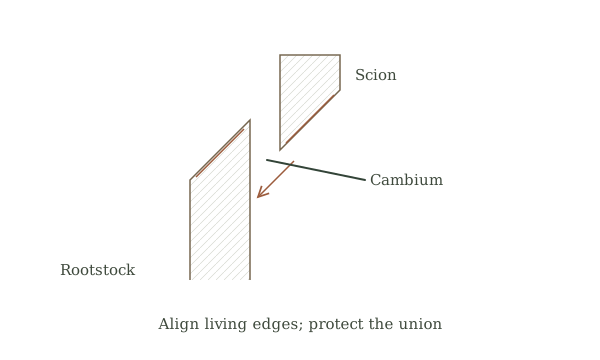
A graft joins a desired fruit variety to a root system with useful characteristics. Success depends on compatibility and contact between living cambium near the bark. Aligning the middle of two pieces is not enough when their diameters differ.
What you’ll need
Tools
- Grafting knife
- Pruners
Materials
- Compatible rootstock
- Dormant scion
- Grafting tape
Before you begin
Safety & limits
- Knife work requires supervised practice. Do not climb or make overhead grafts as a beginner.
Work carefully, in order
The method
- 01
Choose compatible material
Ask a nursery for a rootstock and scion combination suitable to your climate and desired mature tree size. Identify the variety and rootstock in your record. A seedling apple is not a predictable substitute for a named dwarfing rootstock.
- 02
Learn the tissues
On a spare twig locate bark, the thin living region beneath it, and woody interior. Sketch the cut surfaces. Plan to align cambium along at least one side if diameters differ, rather than centering a thin scion in a thick stock.
- 03
Practice before cutting
Have an experienced grafter demonstrate a simple splice or other appropriate method. Work on supported waste pieces with hands outside the blade path. Practice producing flat matching faces without repeatedly trimming them smaller.
- 04
Join and protect
At the locally appropriate season, make the demonstrated cuts, bring surfaces together promptly, and secure them with suitable grafting material. Protect exposed surfaces from drying according to the method. This overview does not replace a supervised knife demonstration.
- 05
Follow the union
Label the graft and inspect for movement, desiccation, and binding material that begins to constrict growth. Remove unwanted rootstock shoots with guidance. A bud opening may use stored reserves; continued growth and a sound union are stronger evidence of success.
Mistakes to avoid
- Assuming any two fruit trees are compatible
- Aligning centers instead of cambium
- Leaving constricting wrapping unchecked
If it isn’t working
Scion shrivels
Review storage, timing, and sealing with a nursery.
Union moves
Support it and avoid wind loading; do not test by bending.
Then & now
Historical context
Grafting preserves a selected variety without growing it from genetically variable seed.
The modern equivalent
A nursery-grafted tree is a practical option; learning the union still helps with planting depth and sucker identification.
Sources & review
Editorial draft — specialist review pending. Written 2026-09-20. Sources support the stated scope; this page has not been professionally certified.
This entry describes general practice. A topic-specific source review is still required before it can be marked reviewed.
How this manual handles evidence →