Why it matters
Accessible food can condition wildlife to seek people, threatening both animals and visitors. Requirements vary by park and species; a generic hanging method is not universally accepted or effective.
What you’ll need
Tools
- Current land-manager guidance
- Approved container or locker
Materials
- Food and scented items
- Waste bags
Before this skill
- Campsite Selection
Before you begin
Safety & limits
- Follow the exact rules for the site. Some areas require a bear-resistant canister or locker; do not assume a tree hang is permitted.
- Never feed wildlife or leave food, trash, toiletries or cooking residue accessible.
Work carefully, in order
The method
- 01
Check before departure
Read current storage rules for the particular park, route and campsite. Obtain a required approved container or plan a different trip if it is unavailable.
- 02
Identify attractants
Include food, scraps, wrappers, scented toiletries and other items identified by the land manager. Package them so they fit the required container and can be closed fully.
- 03
Set the camp zones
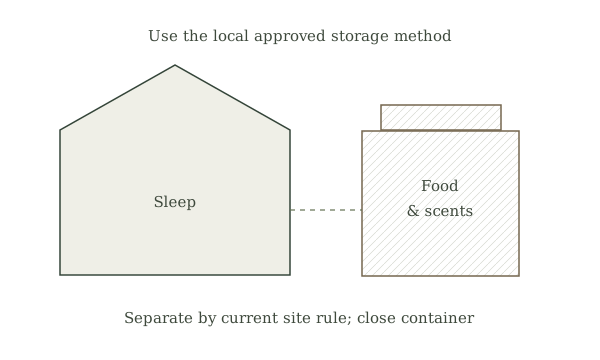
Use the location and separation specified locally for eating, cooking and sleeping. Keep an approved container closed and placed according to its maker and park instructions.
- 04
Manage every break
Do not leave a pack or meal unattended. Clean cooking surfaces and put all leftovers and waste back into compliant storage promptly.
- 05
Pack out and report
Remove every scrap and follow park directions if wildlife obtained food or approached camp. Change plans rather than trying to train or confront an animal yourself.
Mistakes to avoid
- Relying on an odor-proof bag where a canister is required
- Leaving toiletries out because they are not food
- Assuming a tree hang is allowed everywhere
If it isn’t working
The approved container is full
Reduce supplies or obtain another compliant container before leaving the trailhead.
An animal reaches food
Move to safety, follow park instructions and report the incident.
Then & now
Historical context
Travelers once hung provisions or used guarded stores. Current wildlife management specifies containers, lockers and distances for particular areas.
The modern equivalent
Designated food lockers and certified containers reduce improvised camp storage decisions when used correctly.
Sources & review
Editorial draft — specialist review pending. Written 2026-09-24. Sources support the stated scope; this page has not been professionally certified.
- National Park Service — Bear Safety: Storing Food ↗
Park-specific food storage requirements and avoiding wildlife conditioning. Checked 2026-09-24.
- Leave No Trace — Seven Principles ↗
Land-manager rules, durable surfaces and pack-out practices. Checked 2026-09-24.