Why it matters
Names are easy to mix up and the wrong application can capsize or slip. A square knot is unsuitable as a general rope-to-rope connection; a sheet bend has its own limitations.
What you’ll need
Tools
- Two colors of practice cord
- Illustrated source for the named knots
Materials
- Smooth post or small scrap dowels when needed
Before you begin
Safety & limits
- Do not use a square knot to join ropes for a load.
- Do not infer safe working load from a gentle hand test, especially with slick or dissimilar rope.
Work carefully, in order
The method
- 01
Prepare
Lay out two colored practice cords and name the standing and working parts. Use only an unloaded sample and pause to match the cord path to the linked illustrated source before moving to the next stage.
- 02
Form
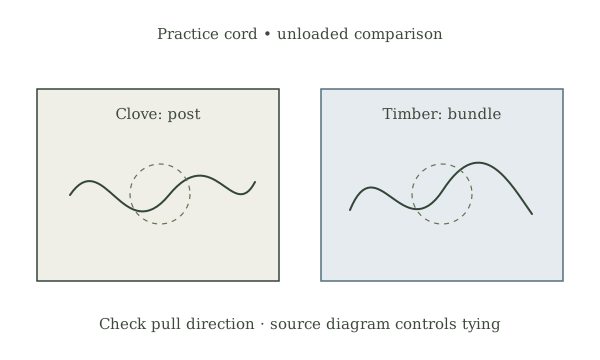
Tie a square knot around a loose bundle, following the illustrated reference and checking the two symmetrical bights. Use only an unloaded sample and pause to match the cord path to the linked illustrated source before moving to the next stage.
- 03
Compare
Remove that knot and form a sheet bend by passing the thinner working end around a bight in the other cord. Use only an unloaded sample and pause to match the cord path to the linked illustrated source before moving to the next stage.
- 04
Inspect
Dress the sheet bend and check the tails against the source illustration before a gentle hand test. Use only an unloaded sample and pause to match the cord path to the linked illustrated source before moving to the next stage.
- 05
Review
Label the two examples by use and retie from memory before checking both against the source. Use only an unloaded sample and pause to match the cord path to the linked illustrated source before moving to the next stage.
Mistakes to avoid
- Using a memorized shape without checking the loaded strand and working end
- Using a practice knot for a rated, moving or human load
- Assuming all cord materials grip equally
If it isn’t working
The knot does not match the reference
Lay the cord down without tension, trace the working end from start to finish and retie from the original source illustration.
The practice knot slips or jams
Stop the hand test, note the cord surface and loading direction, and use another suitable method for a real task instead of claiming a rating.
Then & now
Historical context
The reef or square knot secured parcels and sails, while bends helped join cordage; modern rated connections are selected for a defined system.
The modern equivalent
Purpose-built rated fittings and manufacturer-specified knots apply when a task has a defined load or safety requirement. A practice model teaches identification only.
Sources & review
Editorial draft — specialist review pending. Written 2026-09-24. Sources support the stated scope; this page has not been professionally certified.
- Animated Knots by Grog — Square Knot And Sheet Bend ↗
Illustrated tying sequence, distinct intended application and limits; follow the linked primary instructional source. Checked 2026-09-24.
- Animated Knots by Grog — Square Knot And Sheet Bend ↗
Illustrated tying sequence, distinct intended application and limits; follow the linked primary instructional source. Checked 2026-09-24.