Why it matters
A smokehouse combines equipment, a heat source and a food-handling workflow. The building cannot validate the food process. This planning guide produces a facility brief and links to the smoking guides for product-specific processing controls.
What you’ll need
Tools
- Notebook and layout sketch
- Selected equipment manual
- Current product-specific smoking guidance
Materials
- Approved equipment and design information
- Separate raw and finished-product handling containers
- Cleaning and monitoring plan
Before you begin
Safety & limits
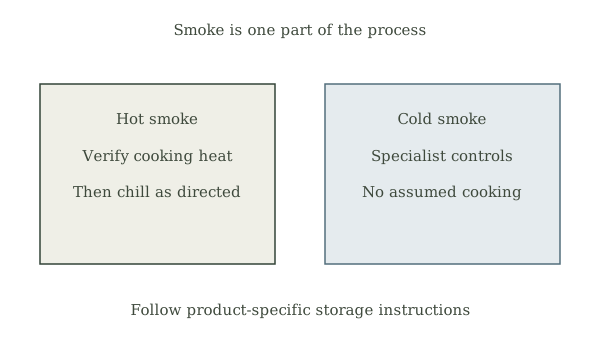
- Do not construct a firebox, flue or smoking chamber from this concept guide. Fire, carbon monoxide, hot surfaces, grease and unsuitable construction materials require qualified assessment. Use smoking equipment only in its approved location and configuration. Cold smoking and shelf-stable products require validated specialist controls; smoke alone is not proof of safe preservation.
Work carefully, in order
The method
- 01
Define equipment and product
Record whether the intended product is cooked hot-smoked food or a specialist preparation. Select a complete authoritative food process before considering a facility. Identify purpose-made equipment and its manual. Do not assume a historical smokehouse or an improvised cabinet can carry out the chosen process.
- 02
Map the location and hazards
On a site plan, mark buildings, openings, access, fuel handling and the proposed equipment location. Ask a qualified fire and building specialist to confirm suitability and required separation. Follow the equipment’s location instructions; do not invent universal fire clearances or enclose an outdoor cooker.
- 03
Separate heat, smoke and monitoring
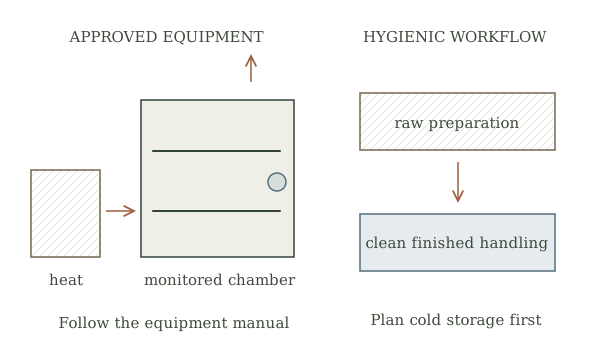
Draw the equipment’s heat source, food chamber and approved air path as distinct parts. Record where chamber and food temperatures are measured according to the process and manual. Leave unresolved performance questions for the supplier. A visible stream of smoke does not demonstrate temperature control.
- 04
Plan hygienic movement
Draw separate raw-food preparation and finished-product handling routes, with clean tools and handwashing access. Keep fuel and ash away from food-contact areas. Confirm that surfaces and racks can be cleaned as specified. Include sufficient appropriate cold storage for the finished batch before operation is considered.
- 05
Coordinate the complete facility
Obtain qualified review of structure, fire safety, services, cleanability and the selected equipment configuration. Confirm any local approvals and whether the use is domestic or commercial. Keep the facility brief separate from the product’s curing or smoking instructions; both must be suitable before food is processed.
- 06
Commission and retain records
Have the approved equipment installed and commissioned according to its instructions. Document monitoring, cleaning and maintenance arrangements. If the system cannot meet the selected process, stop and resolve the mismatch. Use the hot/cold smoking guides for the complete processing workflow, not this diagram as a recipe.
Mistakes to avoid
- Treating a smoking chamber as a food-preservation process
- Enclosing equipment intended for outdoor use
- Planning finished-food handling through the raw-food area
If it isn’t working
The equipment cannot hold required conditions
Stop the proposed process and consult the supplier and food-safety specialist; do not compensate with longer unvalidated smoking.
Cleaning needs inaccessible disassembly
Resolve cleanability with the equipment supplier before use rather than allowing grease and residue to accumulate.
Then & now
Historical context
Smokehouses supported household meat traditions, often alongside curing. Their historical appearance does not prove that a modern batch will be safely cooked, cooled or stored.
The modern equivalent
Approved smoking equipment within an assessed facility, with validated product-specific processes and recorded controls.
Sources & review
Editorial draft — specialist review pending. Written 2026-09-30. Sources support the stated scope; this page has not been professionally certified.
- USDA FSIS — Smoking Meat and Poultry ↗
Purpose-made outdoor equipment and food/chamber monitoring; food processing requires the complete current instructions. Checked 2026-09-30.
- National Center for Home Food Preservation — Curing and Smoking ↗
The distinction between curing, smoke and a controlled food-preservation process; this guide supplies no curing recipe. Checked 2026-09-30.