Why it matters
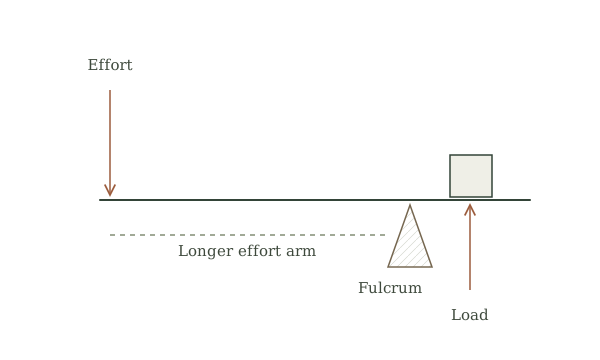
A lever rotates about a support called a fulcrum. In an ideal balanced system, force multiplied by perpendicular distance from the fulcrum is equal on both sides. The benefit is reduced effort at the cost of greater movement, not free energy.
What you’ll need
Tools
- Ruler
Materials
- Pencil
- Small eraser
Before you begin
Safety & limits
- Do not lift vehicles, people, or heavy objects with an improvised lever.
Work carefully, in order
The method
- 01
Build a tiny model
Balance a ruler across a pencil on a clear table. Put a small eraser near one end and hold the other end lightly. Keep the exercise small enough that a slip has no consequence.
- 02
Move the fulcrum
Bring the pencil closer to the eraser and compare the effort needed to lift it slightly. Notice that the hand moves farther while the eraser moves less. Record the distances from support to load and support to effort.
- 03
Use the ratio
If the effort arm is four times the load arm, ideal effort is one quarter of the load force. Use perpendicular distances for the moment calculation. Real friction, bending, and changing geometry make practical behavior less ideal.
- 04
Trace the support load
Draw the forces on the ruler and on the pencil. The fulcrum also carries force, so an easy hand movement does not imply a lightly loaded support. This is why improvised lifting can crush the support or suddenly slip.
- 05
Recognize real examples
Compare a pry bar, wheelbarrow, and scissors. Locate load, effort, and pivot for each. For any actual heavy task, use equipment designed for the load and keep people away from pinch and fall zones rather than enlarging the ruler experiment.
Mistakes to avoid
- Ignoring the fulcrum’s load
- Assuming longer always means safer
- Using arm length instead of perpendicular distance in angled systems
If it isn’t working
Model slips
Use a smaller load and a controlled tabletop setup.
Prediction differs
Check friction, geometry, and ruler bending.
Then & now
Historical context
Levers appear in tools, presses, and lifting devices across many cultures.
The modern equivalent
Rated jacks and lifting equipment turn the principle into a controlled system.
Sources & review
Editorial draft — specialist review pending. Written 2026-09-20. Sources support the stated scope; this page has not been professionally certified.
This entry describes general practice. A topic-specific source review is still required before it can be marked reviewed.
How this manual handles evidence →