Why it matters
Fish changes quickly after capture. Ice and reliable refrigeration preserve quality while a clean bench prevents raw juices reaching food ready to eat. An appealing smell or bright eye can help judge freshness but cannot prove microbiological safety, and fish from an unknown water body may require local consumption advice.
What you’ll need
Tools
- Refrigerator thermometer
- Clean cooler or tray with ice
- Knife and dedicated board
- Clean cloths
Materials
- Identified fish from a reputable source
- Food-grade wrapping or lidded container
- Batch label
Before this skill
- Kitchen Hygiene
- Using Food Thermometers
Before you begin
Safety & limits
- Follow local species, harvest and fish-consumption advisories. Do not use an unidentified catch, dead shellfish or visibly spoiled fish.
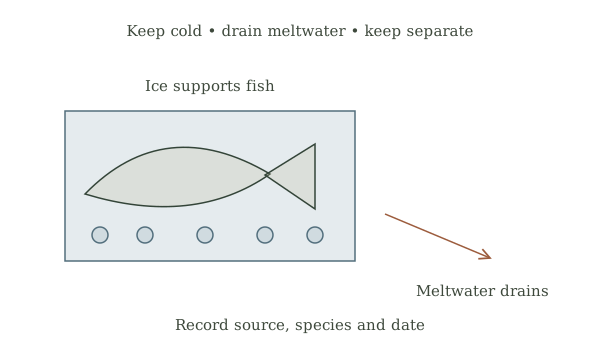
- Keep fish on ice or in a refrigerator at the recommended temperature and keep melted ice water away from the flesh. FDA advises using refrigerated seafood within its stated short window or wrapping and freezing it.
- Raw fish and its tools must remain separate from cooked food. Cooking, parasite control and raw-consumption questions need specific authoritative guidance; this guide does not authorize raw fish service.
Work carefully, in order
The method
- 01
Know the source
For purchased fish, check package condition, sell-by or pack information and that the display keeps it cold. For a personal catch, identify the species and check the rules and advisories for the exact water. Decide before the trip how the fish will remain chilled and when it will be prepared.
- 02
Move it promptly into cold storage
Put the fish on clean ice that drains away or in a leak-resistant tray in the refrigerator or freezer as soon as possible. Verify refrigerator temperature with an appliance thermometer. Avoid leaving a catch in a warm car, direct sun or standing meltwater while finishing other tasks.
- 03
Set up a clean preparation area
Wash hands and separate the fish board, knife and containers from ready-to-eat food. Inspect for damaged flesh or package leaks. Scale, gut or fillet only if you have the right skill and a safe, steady workspace; take care with sharp bones and spines and seek competent instruction for unfamiliar species.
- 04
Portion and identify
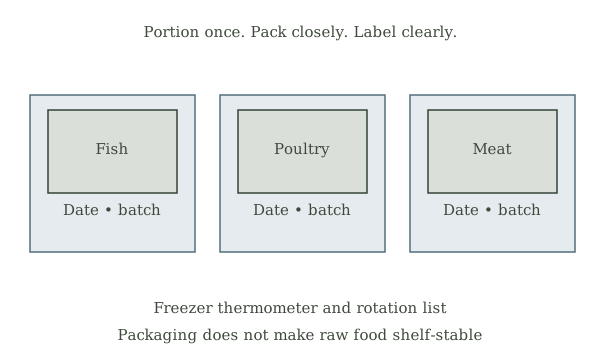
Remove obvious bones as appropriate but assume fine pin bones may remain, especially when serving children. Record the species, source and date, and distinguish raw from cooked packages. Decide immediately whether to use the fish under current refrigerated guidance or wrap and freeze it for a longer plan.
- 05
Cook and clean up
When preparing a meal, follow the government temperature chart and the product’s instructions. Thoroughly clean raw-fish contact surfaces, tools and hands. If fish was left warm or handling is uncertain, do not treat a strong flavor, marinade, vinegar or later smoke as a substitute for safe source and cold storage.
Mistakes to avoid
- Letting fish sit in meltwater.
- Treating an odor check as proof of safety.
- Using a filleting board for finished food without washing and sanitizing.
If it isn’t working
A caught fish cannot be identified
Keep it out of the kitchen until a qualified local source identifies it and confirms harvesting and consumption guidance.
The fish thawed in transit
Assess time and temperature using official food-safety guidance; do not simply put it back on ice and reset the clock.
Then & now
Historical context
Fishing households traditionally brought a catch to shore for rapid cleaning and icing. Modern refrigeration, fishery advisories and species identification make decisions more precise, especially for fish intended for children or pregnant people.
The modern equivalent
A draining ice bed, appliance thermometer and documented source make an ordinary fish-handling workflow easier to verify than relying on appearance alone.
Sources & review
Editorial draft — specialist review pending. Written 2026-09-24. Sources support the stated scope; this page has not been professionally certified.
- FDA — selecting and serving fresh and frozen seafood safely ↗
Selecting seafood, prompt cold storage, separation and thawing. Checked 2026-09-24.
- FoodSafety.gov — cold food storage chart ↗
Cold-storage windows differ among fish and shellfish. Checked 2026-09-24.