Why it matters
Collection is the first stage of a water workflow. A beautiful stream may carry microbes; a chemically suspect source may be unsuitable even after boiling. The outcome here is a labeled collection log and a protected transfer to the separate treatment guide. The worked exercise uses potable tap water at a permitted bank-side practice station, so learners need not consume untreated field water.
What you’ll need
Tools
- Marked collection vessel or scoop
- Treatment equipment and its instructions
- Clean receiving bottle and lid
- Notebook
Materials
- Potable practice water
- Separate tray for dirty gear
- Accessible approved collection point
Before this skill
- Water Treatment Methods
Before you begin
Safety & limits
- Keep away from swift water, unstable banks and slippery rocks. Do not wade or lean beyond secure footing to obtain a clearer-looking sample.
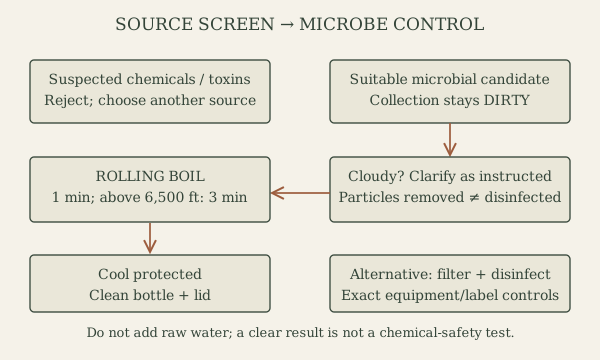
- Reject sources with suspected fuel, industrial runoff, harmful toxins, sewage incidents or chemical advisories. Boiling and disinfecting do not solve chemical contamination.
- The exercise simulates dirty water using a labeled vessel and potable water; do not add soil, dyes or cleaners to anything intended for drinking.
Work carefully, in order
The method
- 01
Plan collection before arrival
Check the destination’s water availability and advisories, and carry safe water until the planned source and treatment are available. In the fictional route card, a refill marked on an old map is reported dry: amend the plan or carry enough for the route. A map symbol is not confirmation of a present safe supply. Record the backup and the point at which the trip must change.
- 02
Screen the candidate source
From safe ground compare three scenario cards: an accessible freshwater edge with no known advisory, a runoff ditch beside farmland, and a pond with a posted harmful-algae warning. Select only the first for further microbial treatment assessment; reject the known/suspected chemical or toxin hazards. Absence of a warning does not establish safety. Keep raw-water handling separate from water you will drink.
- 03
Set up dirty and clean sides
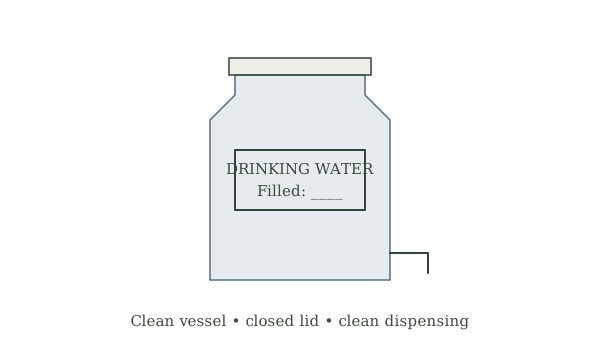
Mark the collection vessel DIRTY and place it on one tray. Put the receiving bottle, lid and treated-water outlet on a separate clean surface. In this drill fill the dirty vessel with potable water to practise the transfer. Do not let the bottle mouth touch the tray or dirty vessel rim; have the leader point out any unnoticed cross-contact before proceeding.
- 04
Collect without a new terrain hazard
Use the reachable edge rather than entering moving water or standing on wet logs. Obtain water with the dedicated scoop or vessel, keeping debris out where practical. If the only access requires a risky reach, abandon that collection point and use the planned reserve/alternative. In the nearby-refuge drill, practise standing and handling only; no water need be taken from the stream.
- 05
Handle sediment as pretreatment
If a real microbial-treatment candidate is cloudy, follow the applicable treatment instructions for settling or coarse clarification before the microbial step. A clean cloth removes some particles, not pathogens. Do not invent a settling time or declare the clearer fraction drinkable. Record “untreated” on the vessel until the full chosen method is completed.
- 06
Hand off and protect the result
Use the water-treatment guide for the exact boiling workflow or a labeled filter-plus-disinfection method. Record source, observed concerns, chosen method and completion, then close the receiving bottle. The instructor introduces a fault: the treated outlet touches the dirty tray. Identify it and follow the equipment’s cleaning instructions before use. Completion means an unbroken clean-side workflow and an honest log, not a claim that all environmental hazards were tested.
Mistakes to avoid
- Calling sediment removal purification
- Using the same mouth or hose for dirty and treated water
- Collecting from a dangerous bank to save carried water
If it isn’t working
The expected refill is unavailable
Use the reserve and change the route before it is exhausted. Do not rely on an unconfirmed further source or continue a dry route because a filter is packed.
Chemical contamination is uncertain
Choose a safer supply or obtain public-health advice. A portable microbial filter is not evidence that pesticides, toxins or fuel have been removed.
Then & now
Historical context
Horace Kephart’s early twentieth-century outdoor notebooks, held by Western Carolina University, illustrate the habit of recording equipment and practical observations. This guide borrows the recordkeeping idea only. Modern CDC advice, rather than an archival clear-water assumption, determines the drinking-water boundary.
The modern equivalent
Carry equipment suited to the actual season and learn with a qualified wilderness instructor. A nearby-refuge practice session prepares decisions; it does not certify independent backcountry competence.
Sources & review
Editorial draft — wilderness instructor review pending. Written 2026-10-06. Sources support the stated scope; this page has not been professionally certified.
- CDC — Water treatment when hiking, camping or traveling ↗
Microbial treatment, rolling-boil duration and elevation adjustment, filter limitations and chemical-contamination exclusions. The practice log is an editorial example; no improvised chemical dose is supplied. Checked 2026-10-06.
- NPS — Hike Smart ↗
Choose a route for the group, check conditions, keep together and set turnaround limits. The arithmetic and imaginary route card here are original examples. Checked 2026-10-06.
- Western Carolina University — Kephart outdoor writing archive ↗
Documents Horace Kephart’s outdoor notebooks and the 1916 expansion of Camping and Woodcraft. Provenance for the written-record tradition, not evidence for modern shelter or medical procedures. Checked 2026-10-06.